Technology
Unleashing the brain's healing power by combining neuroscience and AI.
We aim to address the challenges faced by stroke patients and contribute to improving their quality of life by applying BCI technology that integrates neuroscience and AI.
Activating compensatory pathway between the brain and fingers through BCI.
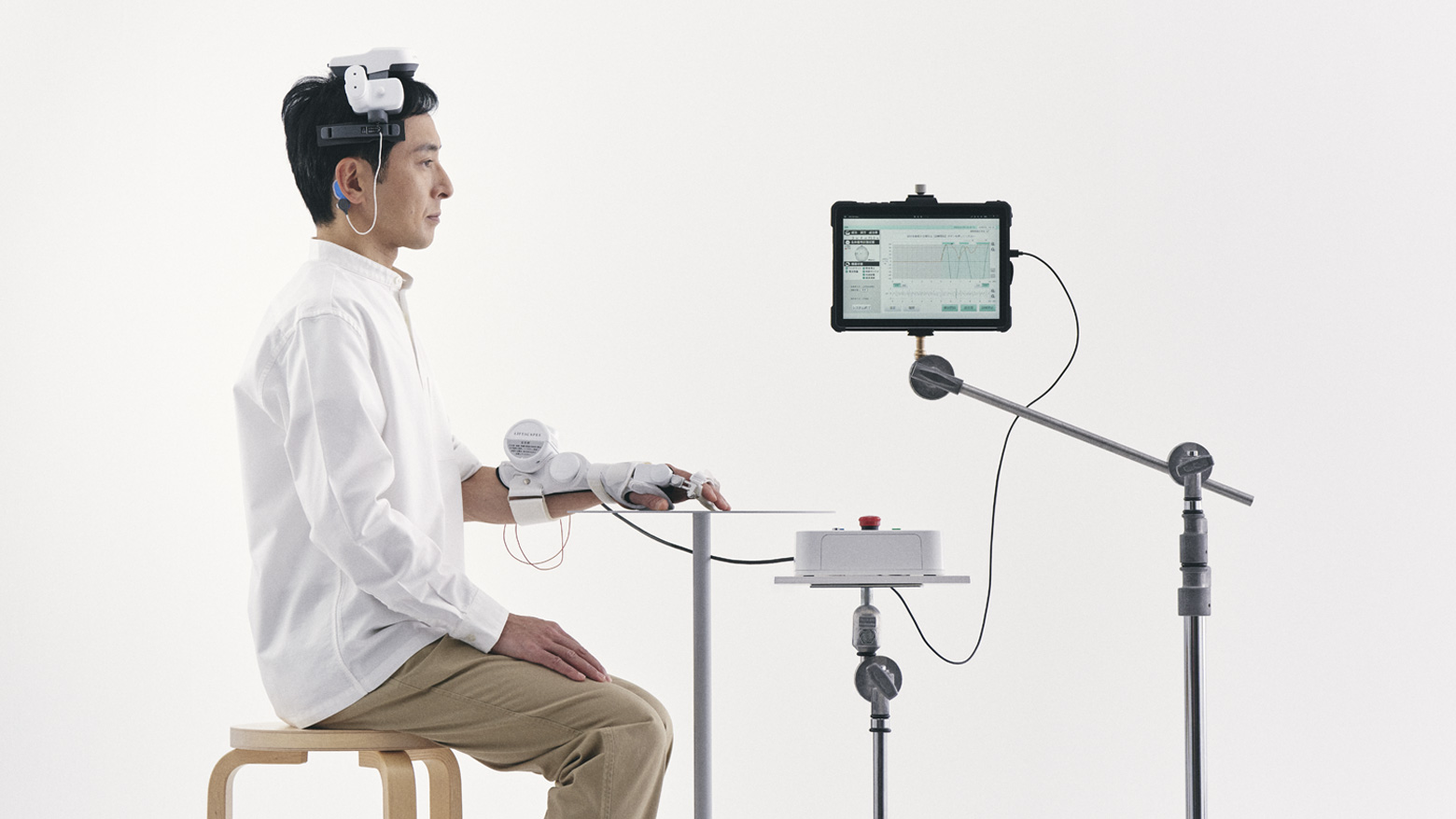
BCI technology uses wearable sensors placed on the scalp to detect neural activity that bypasses the brain regions damaged by stroke. At the same time, it moves a powered orthosis attached to the paralyzed fingers, which is thought to promote the activation of compensatory pathways connecting the brain and the fingers.
(Ushiba and Soekadar, Prog Brain Res. 2016) Research suggests that combining BCI training with appropriate rehabilitation may help activate these compensatory pathways, potentially enabling voluntary hand opening even without the BCI.

This is an illustration of our product utilizing BCI technology.
Product classifications under the Pharmaceutical and Medical Device Act may differ from academic interpretations of BCI’s therapeutic principles.
Please check “Product” page for more details.
Research on Upper Limb Rehabilitation Using BCI Technology
A growing body of international research has reported the effectiveness of BCI technology for motor recovery of the upper limb in patients with post-stroke hemiplegia (Kruse et al. BMC Neurology 2020 (Level 1), etc.). BCI-based training is also included in the Japan Stroke Society’s “Guidelines for the Treatment of Stroke 2021 (revised 2023).”
LIFESCAPES works closely with the Ushiba Lab at Keio University as a company utilizing its research outcomes and continues to explore the possibilities of BCI.